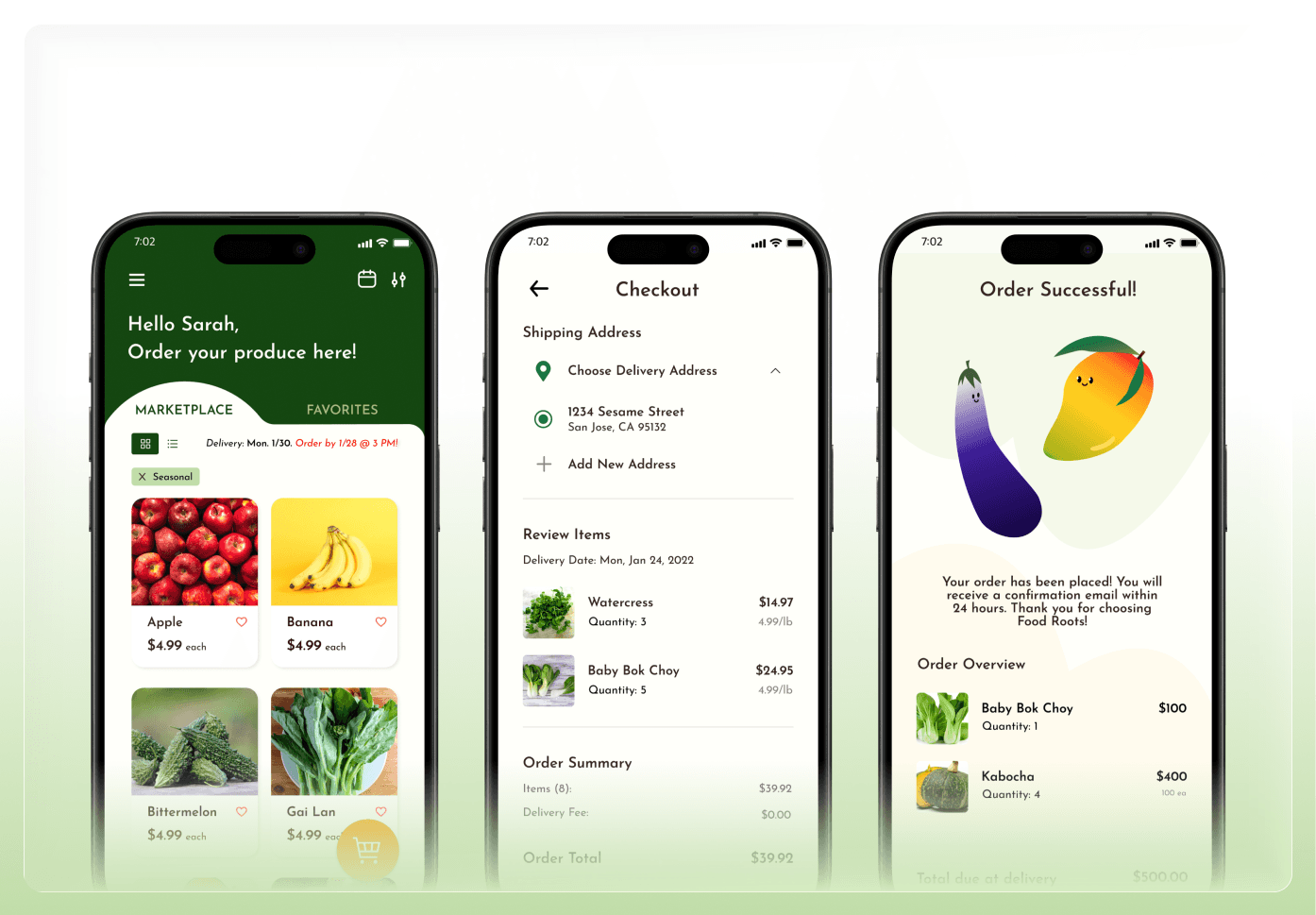
Connecting Communities for Equitable Food Delivery
A mobile app that connect local and sustainably grown
Asian specialty foods to communities and businesses
PRODUCT DESIGN
SHIPPED
MY ROLE
UX Designer
TEAM
Michelle Kou
Michelle Tran Bui
Isaac Wen
Sarah Chang
SKILLS
UI & UX Design
Interaction Design
Prototyping
TIMELINE
Jan - Aug 2022
CONTEXT
Asian Pacific Islander Forward Movement (APIFM) is a nonprofit local to LA that aims to empower Asian and Pacific Islander communities. APIFM is a food hub, where they coordinate orders between farmers and the local businesses.
PROBLEM
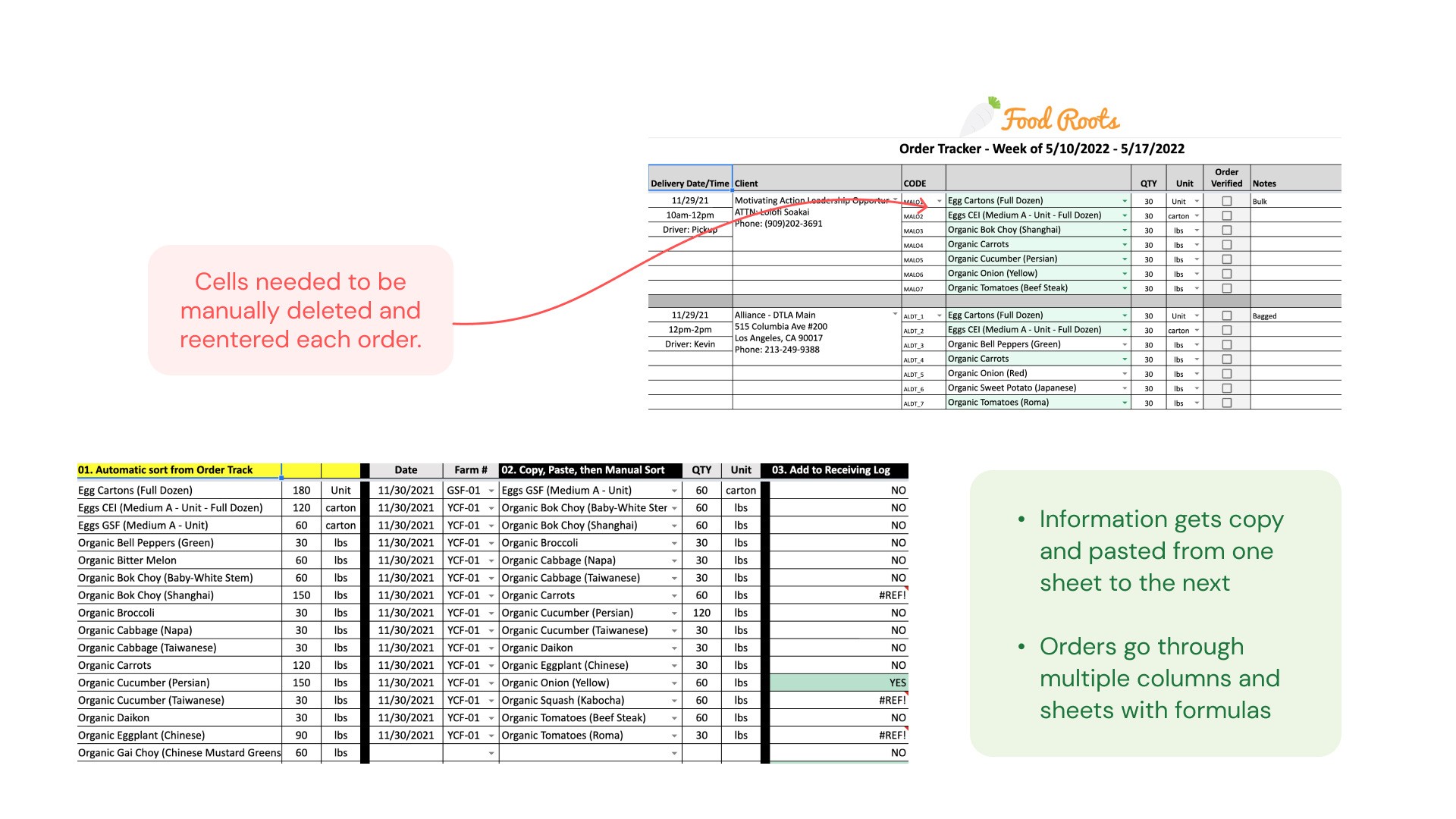
Currently, orders can only be placed through a spreadsheet, which is an inconvenience for both Food Roots and their clients.
PROBLEM 1 (FOR FOOD ROOTS)
With a large number of orders coming in each week, the ordering process (updating inventory, managing spreadsheet formulas, keeping track of delivery dates) are subject to human error.
PROBLEM 2 (FOR CLIENTS)
It is frustrating to order using a spreadsheet as it’s easy to place orders in the wrong cell and hard to filter through the available produce.
THE QUESTION
How can we enhance the order management system to reduce errors and improve the efficiency of delivering produce for clients?
DESIGN CONSTRAINTS
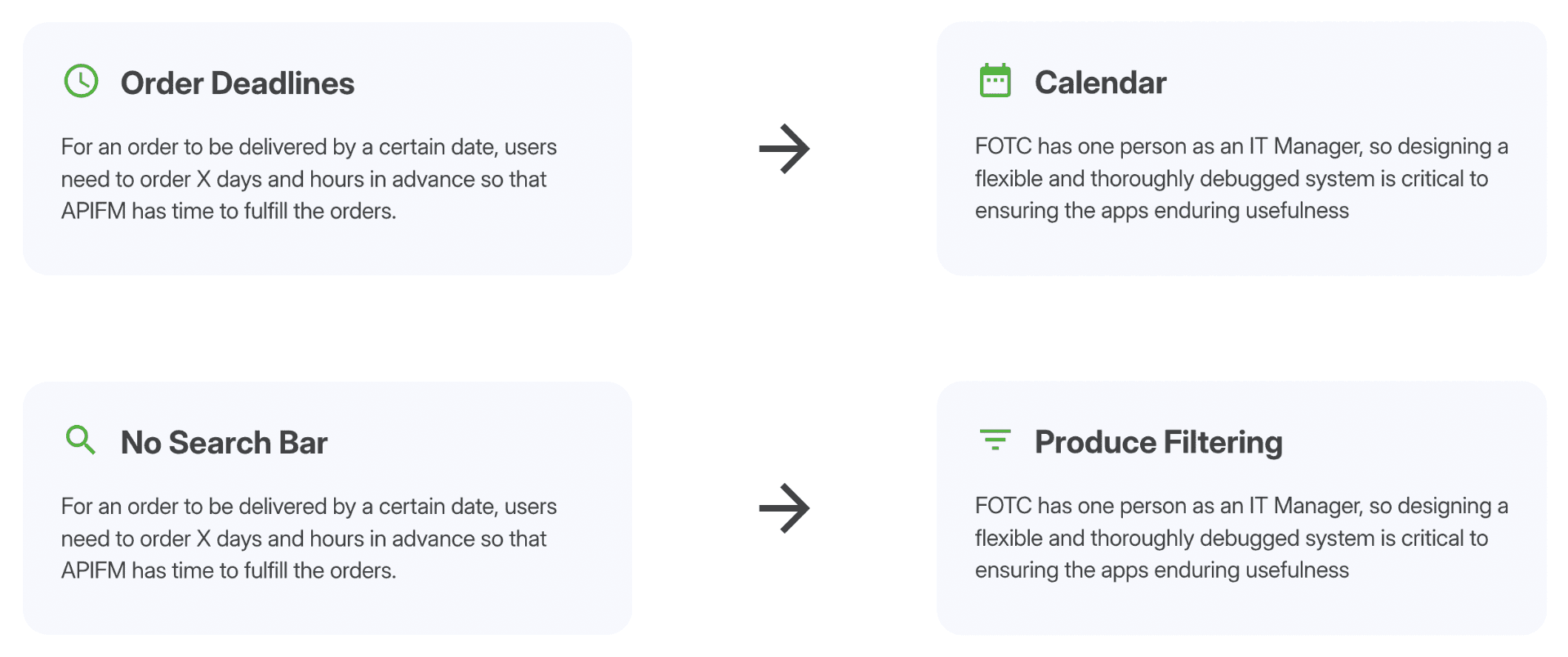
We were informed of important constraints before we work.
COMPETITIVE ANALYSIS
We performed a competitive analysis on 8 grocery/produce delivery apps to compare and contrast features and note strengths and weaknesses to better inform our own designs.
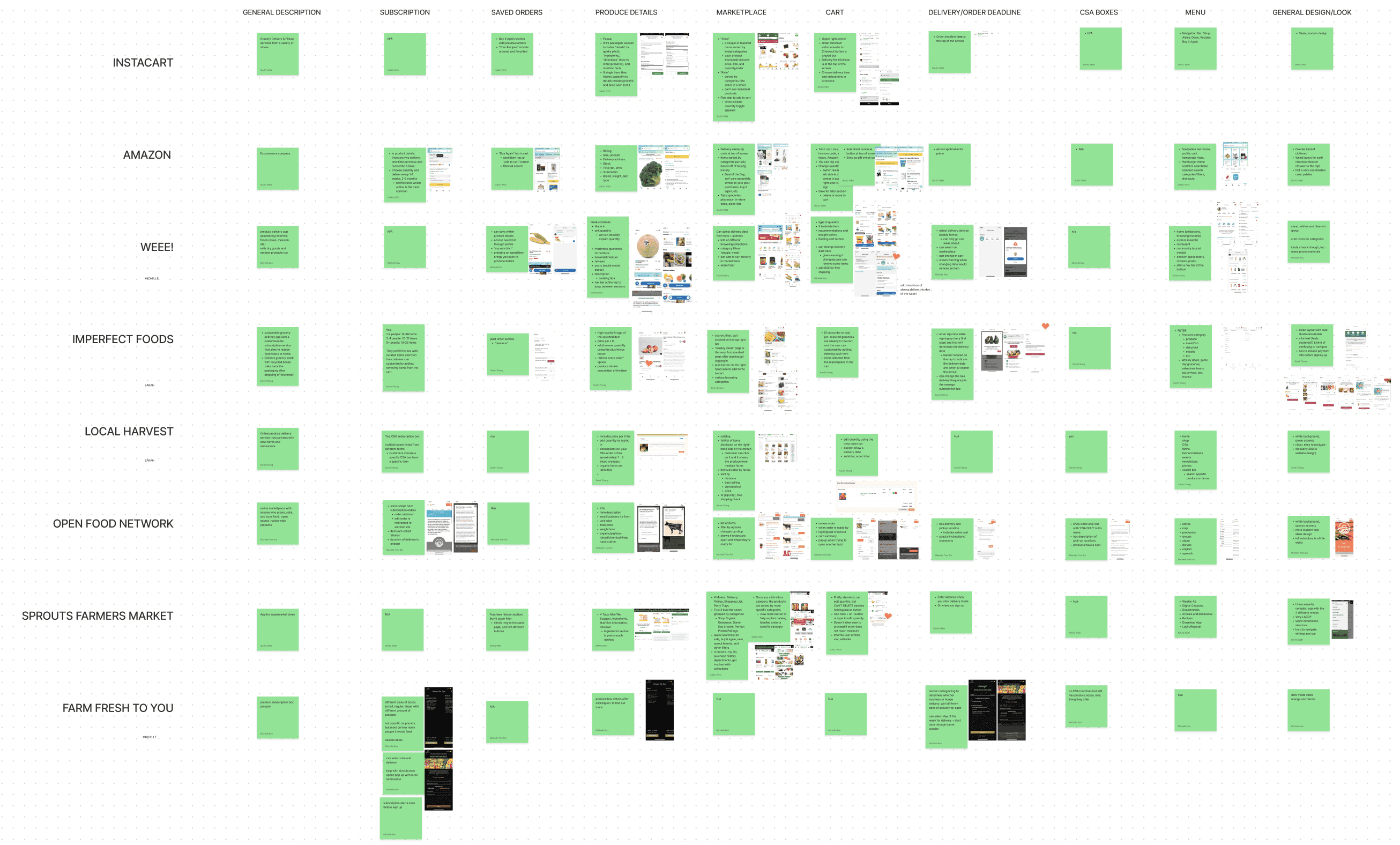
We noticed 4 prevalent feature details across the different apps:
Many apps have adopted a subscription model for products that a user would need frequent shipments of.
Users typically are able to save favorite items or access previous purchases through an order history or “buy again” page.
Some apps with more limited stock only allow orders for the coming week. If an item is only available on certain days, changing the delivery date prompts a warning message.
Visually, white space is necessary to help reduce clutter and the user’s cognitive load, especially on screens like the marketplace that contain a great number of products.
USER INTERVIEW
What would the end user want?
We conducted 5 user interviews with Food Roots users: restaurant owners, chefs, NPO organizers, and cooking instructors. Each 30-minute interview consisted of general questions about their current experience working with Food Roots.




USER INTERVIEW
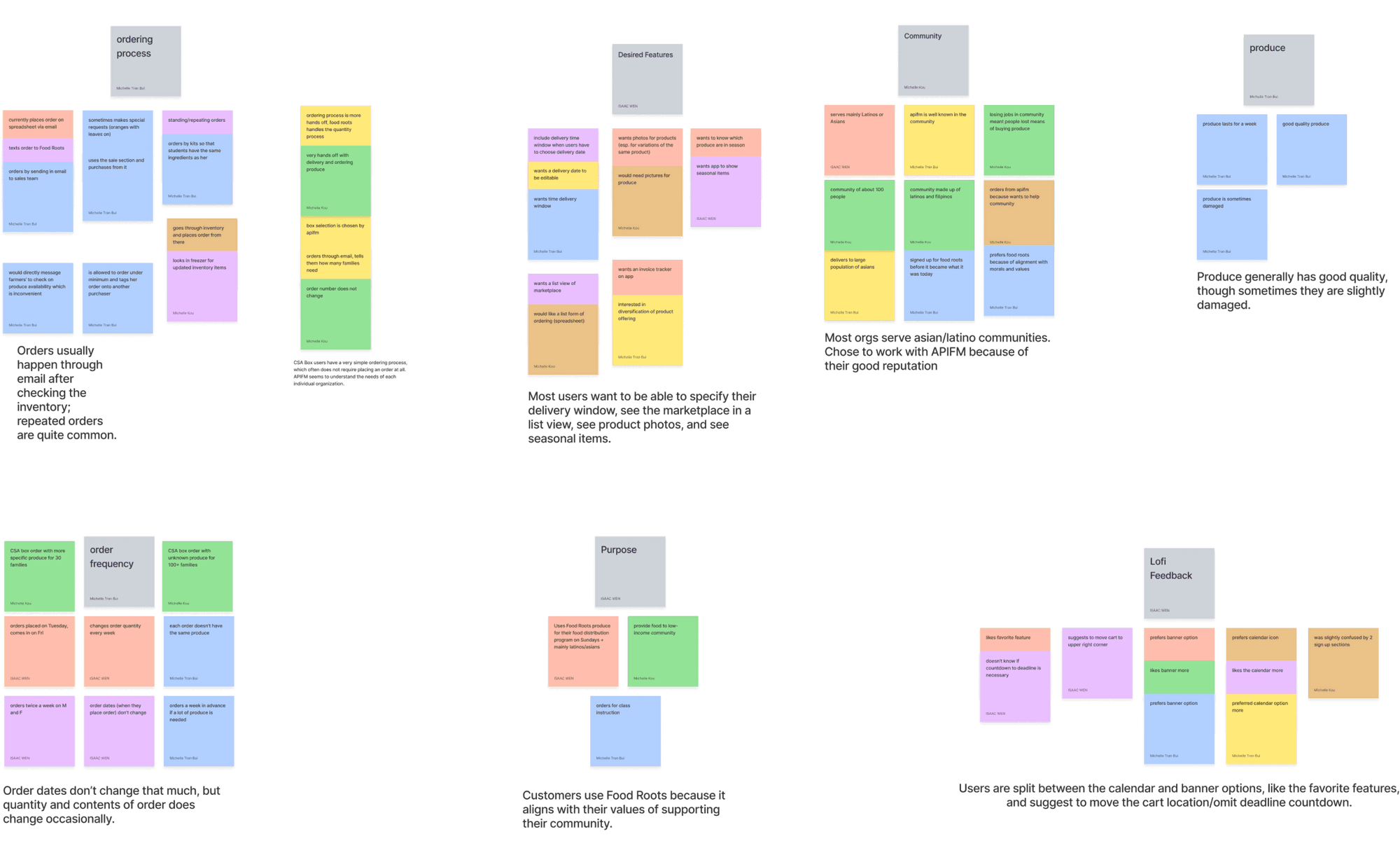
We grouped our findings into categories (delivery patterns, tech literacy, order frequency, and purpose). Through examining these categories, we were able to identify common themes and recurring trends, using them to extract key problems to prioritize.
We conducted 5 user interviews with Food Roots users: restaurant owners, chefs, NPO organizers, and cooking instructors. Each 30-minute interview consisted of general questions about their current experience working with Food Roots, such as:
KEY FEATURES
We identified 4 key features for the grocery marketplace.
Subscription
Place recurring orders that are editable, accomodating for changing demand.
Filter
Easily identify seasonal items without the use of a search bar.
List View + Favorites
Enable quick scrolling to view multiple items at once. Allow users to select favorite items quickly.
Community
Reinforce community support by including all farmer's names.
UNEXPECTED CHALLENGES + IMPROVEMENTS
Setbacks and a new direction for repeated orders
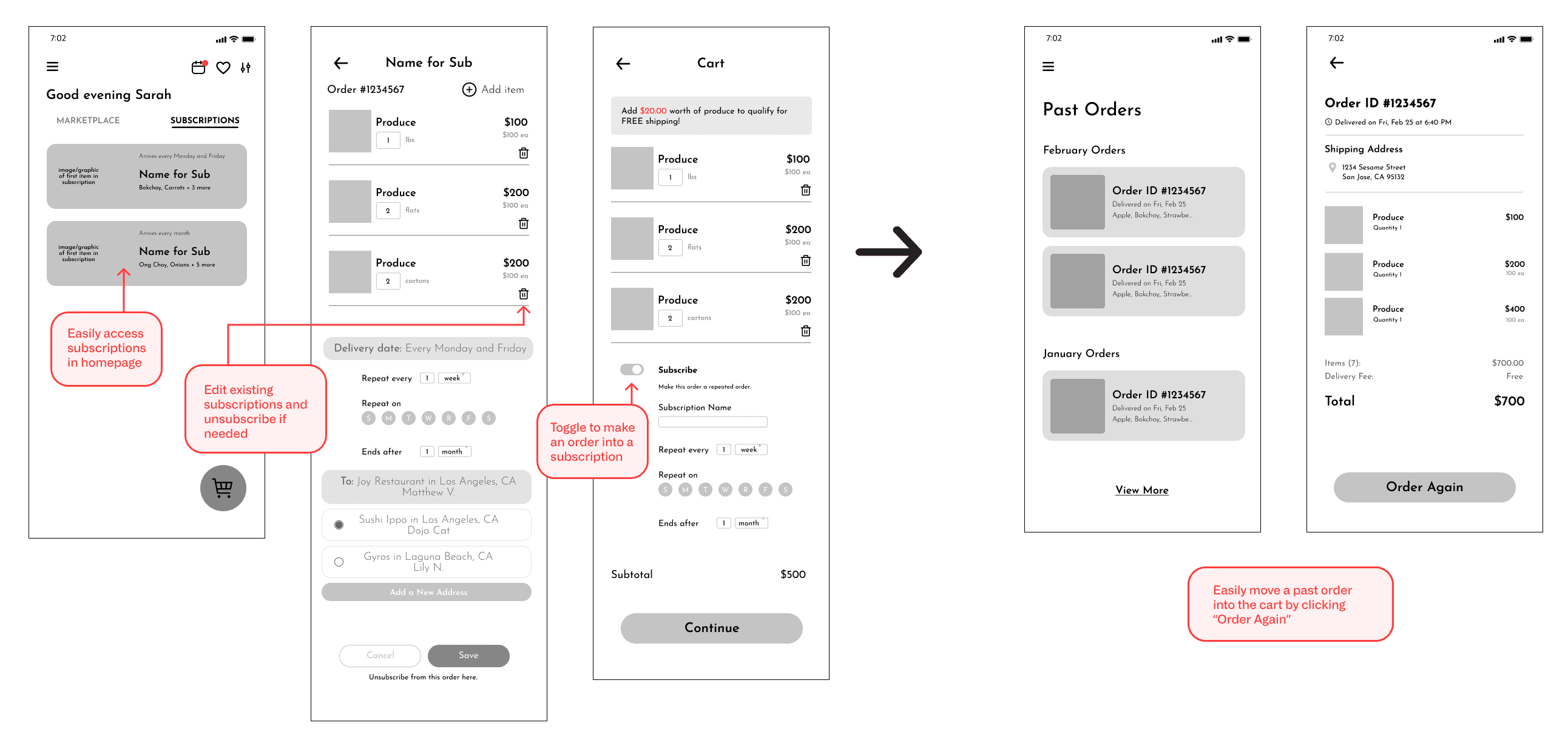
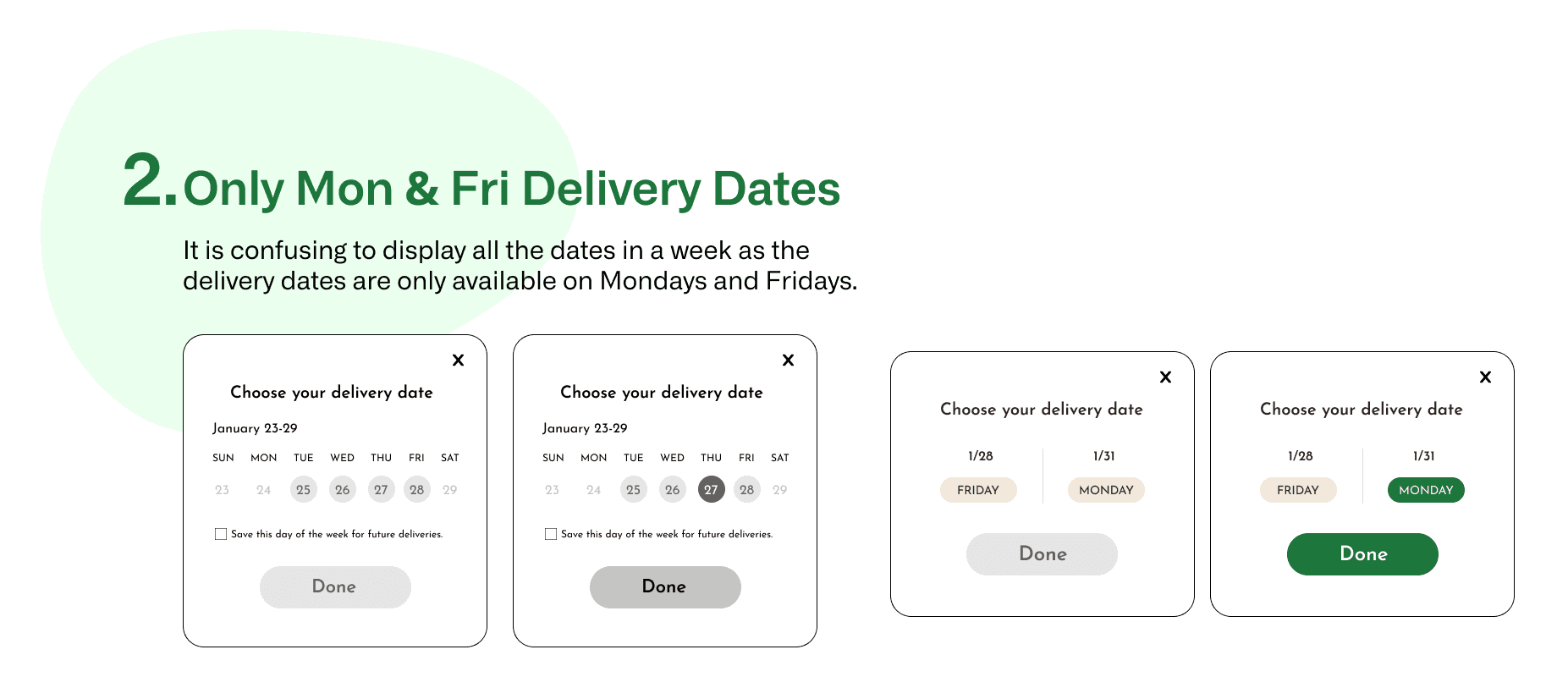
Because of limited staff, Food Roots can only deliver on Mondays and Fridays.
Since produce availability is always changing, users could not order one week in advance, making repeated orders or subscriptions difficult to implement.
Thus, we had to repurpose our subscription feature into a past orders page that enables users to edit and reorder previous purchases.
USABILITY TESTING
We made multiple iterations after conducting 6 usability tests with both Food Roots admin and users.
Final Solution
Set up a Delivery Date
The Deliver Date pop-up allows the user to select a desired delivery date of the week; the marketplace will display the available produce according to the date.
Filter & Sort Produce
Filter and sort a catalog of produce items and easily navigate through the marketplace. The "seasonal" filter is essential for items that are in stock based on the season.
Browse and Add items to the Cart
Browse the produce items by toggling between list & box view, adding to favorites, and clicking each produce to add to the cart
Finalize & Checkout
See the cart and add or edit the delivery address before checking out all the items
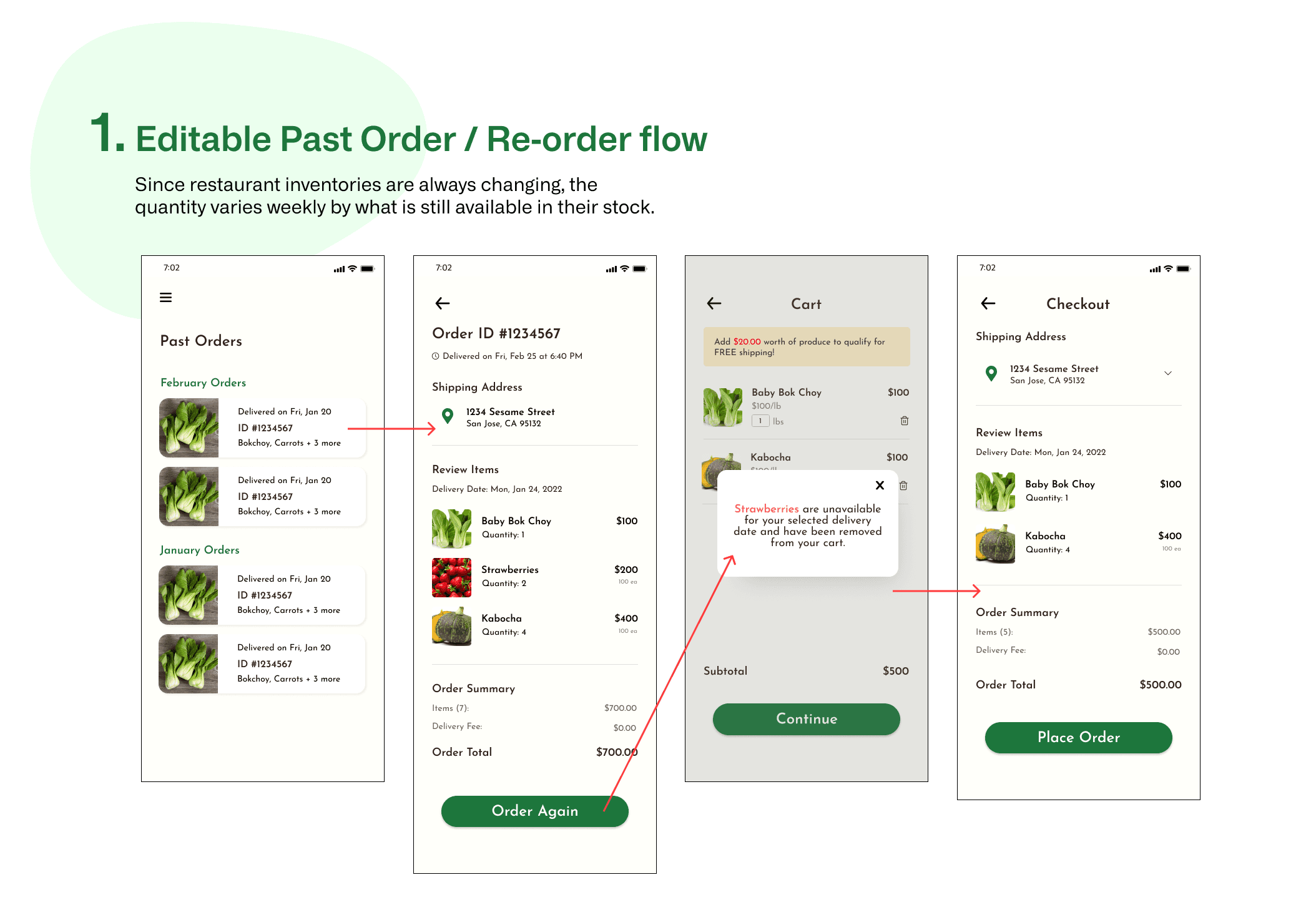
Easily Order Again
Access past orders instead of manually adding all the items again and edit the items accordingly to add to the cart
LEARNINGS
Dev - Design
Regular stand-ups and open dialogue improved our workflow and also enriched my understanding of technical feasibility and designing under those limitations.
Functional Design
As I mapped out user flows, I realized that each element carried a purpose beyond aesthetics. This holistic approach taught me to enhance usability and guide users intuitively, leading to more impactful user experiences.
"So What?"
In the midst of a design iteration, a usability testing session revealed an unexpected block. Users were struggling to understand the delivery date feature.
THANKS TO…
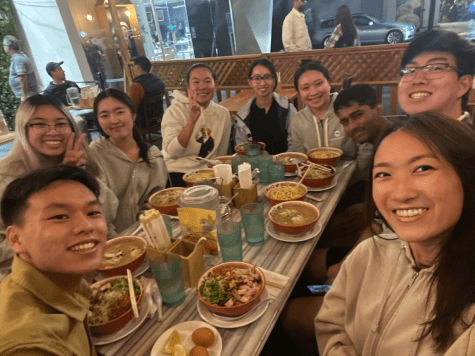
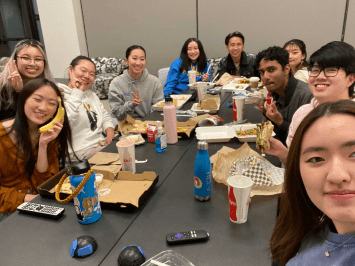
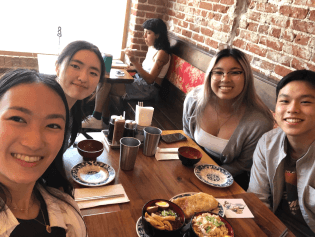
HUGE shout out to my APIFM team for guiding me through my first client-based UX design experience and always bringing laughter and smiles to our worksessions.

Connecting Communities for Equitable Food Delivery
A mobile app that connect local and sustainably grown Asian specialty foods to communities and businesses
PRODUCT DESIGN
SHIPPED
MY ROLE
UX Designer
TEAM
Michelle Kou
Michelle Tran Bui
Isaac Wen
Sarah Chang
SKILLS
UI & UX Design
Interaction Design
Prototyping
TIMELINE
Jan - Aug 2022
CONTEXT
Asian Pacific Islander Forward Movement (APIFM) is a nonprofit local to LA that aims to empower Asian and Pacific Islander communities. APIFM is a food hub, where they coordinate orders between farmers and the local businesses.
PROBLEM
Currently, orders can only be placed through a spreadsheet, which is an inconvenience for both Food Roots and their clients.
PROBLEM 1 (FOR FOOD ROOTS)
With a large number of orders coming in each week, the ordering process (updating inventory, managing spreadsheet formulas, keeping track of delivery dates) are subject to human error.
PROBLEM 2 (FOR CLIENTS)
It is frustrating to order using a spreadsheet as it’s easy to place orders in the wrong cell and hard to filter through the available produce.
THE QUESTION
How can we enhance the order management system to reduce errors and improve the efficiency of delivering produce for clients?
DESIGN CONSTRAINTS
We were informed of important constraints before we work.
COMPETITIVE ANALYSIS
We performed a competitive analysis on 8 grocery/produce delivery apps to compare and contrast features and note strengths and weaknesses to better inform our own designs.
We noticed 4 prevalent feature details across the different apps:
Many apps have adopted a subscription model for products that a user would need frequent shipments of.
Users typically are able to save favorite items or access previous purchases through an order history or “buy again” page.
Some apps with more limited stock only allow orders for the coming week. If an item is only available on certain days, changing the delivery date prompts a warning message.
Visually, white space is necessary to help reduce clutter and the user’s cognitive load, especially on screens like the marketplace that contain a great number of products.
USER INTERVIEW
What would the end user want?
We conducted 5 user interviews with Food Roots users: restaurant owners, chefs, NPO organizers, and cooking instructors. Each 30-minute interview consisted of general questions about their current experience working with Food Roots, such as:
Why do you order with Food Roots?
During what days or occasions do you order produce?
Can you walk us through your current process of ordering with Food Roots?
USER INTERVIEW
We grouped our findings into categories (delivery patterns, tech literacy, order frequency, and purpose). Through examining these categories, we were able to identify common themes and recurring trends, using them to extract key problems to prioritize.
We conducted 5 user interviews with Food Roots users: restaurant owners, chefs, NPO organizers, and cooking instructors. Each 30-minute interview consisted of general questions about their current experience working with Food Roots, such as:
KEY FEATURES
We identified 4 key features for the grocery marketplace.
Subscription
Place recurring orders that are editable, accomodating for changing demand.
Filter
Easily identify seasonal items without the use of a search bar.
List View + Favorites
Enable quick scrolling to view multiple items at once. Allow users to select favorite items quickly.
Community
Reinforce community support by including all farmer's names.
UNEXPECTED CHALLENGES + IMPROVEMENTS
Setbacks and a new direction for repeated orders
Because of limited staff, Food Roots can only deliver on Mondays and Fridays.
Since produce availability is always changing, users could not order one week in advance, making repeated orders or subscriptions difficult to implement.
Thus, we had to repurpose our subscription feature into a past orders page that enables users to edit and reorder previous purchases.
USABILITY TESTING
We made multiple iterations after conducting 6 usability tests with both Food Roots admin and users.
Final Solution
Set up a Delivery Date
The Deliver Date pop-up allows the user to select a desired delivery date of the week; the marketplace will display the available produce according to the date.
Filter & Sort Produce
Filter and sort a catalog of produce items and easily navigate through the marketplace. The "seasonal" filter is essential for items that are in stock based on the season.
Browse and Add items to the Cart
Browse the produce items by toggling between list & box view, adding to favorites, and clicking each produce to add to the cart
Finalize & Checkout
See the cart and add or edit the delivery address before checking out all the items
Easily Order Again
Access past orders instead of manually adding all the items again and edit the items accordingly to add to the cart
LEARNINGS
Dev - Design
Regular stand-ups and open dialogue improved our workflow and also enriched my understanding of technical feasibility and designing under those limitations.
Functional Design
As I mapped out user flows, I realized that each element carried a purpose beyond aesthetics. This holistic approach taught me to enhance usability and guide users intuitively, leading to more impactful user experiences.
"So What?"
In the midst of a design iteration, a usability testing session revealed an unexpected block. Users were struggling to understand the delivery date feature.
THANKS TO…
HUGE shout out to my APIFM team for guiding me through my first client-based UX design experience and always bringing laughter and smiles to our worksessions.
Connecting Communities for Equitable Food Delivery
A mobile app that connect local and sustainably grown
Asian specialty foods to communities and businesses
PRODUCT DESIGN
SHIPPED
MY ROLE
UX Designer
TEAM
Michelle Kou
Michelle Tran Bui
Isaac Wen
Sarah Chang
SKILLS
UI & UX Design
Interaction Design
Prototyping
TIMELINE
Jan - Aug 2022
CONTEXT
Asian Pacific Islander Forward Movement (APIFM) is a nonprofit local to LA that aims to empower Asian and Pacific Islander communities. APIFM is a food hub, where they coordinate orders between farmers and the local businesses.
PROBLEM
Currently, orders can only be placed through a spreadsheet, which is an inconvenience for both Food Roots and their clients.
PROBLEM 1 (FOR FOOD ROOTS)
With a large number of orders coming in each week, the ordering process (updating inventory, managing spreadsheet formulas, keeping track of delivery dates) are subject to human error.
PROBLEM 2 (FOR CLIENTS)
It is frustrating to order using a spreadsheet as it’s easy to place orders in the wrong cell and hard to filter through the available produce.
THE QUESTION
How can we enhance the order management system to reduce errors and improve the efficiency of delivering produce for clients?
DESIGN CONSTRAINTS
We were informed of important constraints before we work.
COMPETITIVE ANALYSIS
We performed a competitive analysis on 8 grocery/produce delivery apps to compare and contrast features and note strengths and weaknesses to better inform our own designs.
We noticed 4 prevalent feature details across the different apps:
Many apps have adopted a subscription model for products that a user would need frequent shipments of.
Users typically are able to save favorite items or access previous purchases through an order history or “buy again” page.
Some apps with more limited stock only allow orders for the coming week. If an item is only available on certain days, changing the delivery date prompts a warning message.
Visually, white space is necessary to help reduce clutter and the user’s cognitive load, especially on screens like the marketplace that contain a great number of products.
USER INTERVIEW
What would the end user want?
We conducted 5 user interviews with Food Roots users: restaurant owners, chefs, NPO organizers, and cooking instructors. Each 30-minute interview consisted of general questions about their current experience working with Food Roots, such as:
Why do you order with Food Roots?
During what days or occasions do you order produce?
Can you walk us through your current process of ordering with Food Roots?
USER INTERVIEW
We grouped our findings into categories (delivery patterns, tech literacy, order frequency, and purpose). Through examining these categories, we were able to identify common themes and recurring trends, using them to extract key problems to prioritize.
We conducted 5 user interviews with Food Roots users: restaurant owners, chefs, NPO organizers, and cooking instructors. Each 30-minute interview consisted of general questions about their current experience working with Food Roots, such as:
KEY FEATURES
We identified 4 key features for the grocery marketplace.
Subscription
Place recurring orders that are editable, accomodating for changing demand.
Filter
Easily identify seasonal items without the use of a search bar.
List View + Favorites
Enable quick scrolling to view multiple items at once. Allow users to select favorite items quickly.
Community
Reinforce community support by including all farmer's names.
UNEXPECTED CHALLENGES + IMPROVEMENTS
Setbacks and a new direction for repeated orders
Because of limited staff, Food Roots can only deliver on Mondays and Fridays.
Since produce availability is always changing, users could not order one week in advance, making repeated orders or subscriptions difficult to implement.
Thus, we had to repurpose our subscription feature into a past orders page that enables users to edit and reorder previous purchases.
USABILITY TESTING
We made multiple iterations after conducting 6 usability tests with both Food Roots admin and users.
Final Solution
Set up a Delivery Date
The Deliver Date pop-up allows the user to select a desired delivery date of the week; the marketplace will display the available produce according to the date.
Filter & Sort Produce
Filter and sort a catalog of produce items and easily navigate through the marketplace. The "seasonal" filter is essential for items that are in stock based on the season.
Browse and Add items to the Cart
Browse the produce items by toggling between list & box view, adding to favorites, and clicking each produce to add to the cart
Finalize & Checkout
See the cart and add or edit the delivery address before checking out all the items
Easily Order Again
Access past orders instead of manually adding all the items again and edit the items accordingly to add to the cart
LEARNINGS
Dev - Design
Regular stand-ups and open dialogue improved our workflow and also enriched my understanding of technical feasibility and designing under those limitations.
Functional Design
As I mapped out user flows, I realized that each element carried a purpose beyond aesthetics. This holistic approach taught me to enhance usability and guide users intuitively, leading to more impactful user experiences.
"So What?"
In the midst of a design iteration, a usability testing session revealed an unexpected block. Users were struggling to understand the delivery date feature.
THANKS TO…
HUGE shout out to my APIFM team for guiding me through my first client-based UX design experience and always bringing laughter and smiles to our worksessions.